
"Come over here, tell me what you see," she said, clutching at the railing and staring down into the void on the other side. Wind pulled at her dress, a wind that made Hiroki uneasy even standing firmly a dozen feet away from the rail.
"I'd ... really rather not."
"I don't pay you to say that you'd rather not," she said. "Now get over here and do what you're told."
Hiroki inched his way over to the railing she was standing against, the wind pulling heavily at his coat. This high up it was cold and gusting, dangerous to even be out on the roof much less against the edge like she was, a metal railing waist-high all that was keeping her from plummeting dozens of stories to the street below.
Hiroki came over to the edge and clung to the rail like a drowning man. He did dumb things as a matter of course, but this was stupid and pointless, and the carelessness with which she took everything made him uneasy.
He looked down, as instructed, and watched as the maw of the city opened up before him. From up here it seemed to go on for miles, the canyon between the buildings an endless row of mirrored windows like obsidian teeth, the street below pulsing with a heartbeat of its own. He felt dizzy just looking at it, silently adjusting his fee upward in his head as he cursed himself for following along with every whim his clients had.
"So, what do you think?"
"I think that I already told you I don't like heights, and this is more than a little high. So ... why don't you tell me why you pulled me all the way up here before I black out and fall to my death."
The woman at his side just smiled, shaking her head. "No reason, really. I like being up here, just to talk and think. I clear my head. I find it relaxing."
Hiroki looked away, staring up at the sky, the low wisps of cloud that looked like skid marks across the orange sky of a fast-approaching night. "So tell me what you see when you look down there."
She was leaning, arms folded, on the railing. The wind and the height seemed to not bother her in the slightest as she peered down at the city below, composing her thoughts. Hiroki felt ill just looking at her heedless of the precipice.
"From up here everyone is the same," she said. "Rich, poor, old, young, they're all just ants moving across the street. I could reach out my finger," she said, her thumb extended in front of her face, "and suddenly dozens of them are gone. Effortless. It makes all of them seem unimportant. A wave of my hand and I could brush them all away."
Hiroki looked over at her, now leaning over the rail with a hand extended, slowly blotting out sections of the street. He felt like he should intervene, pull her back before she slipped. Instead he turned away from the edge and pulled a pack of cigarettes from his coat pocket. "Want one?"
She made a face and waved him off. He shrugged and tapped out a cigarette and lit it, taking a long draw and blowing smoke up at the retreating sun. "You know, some people might say-"
"Some people?" She did look over at him now with a small, lopsided smile.
"Yeah, nosier people than me, of course," Hiroki said. "But some people might say that you come up here and pretend to crush all the people because you feel powerless in your normal day-to-day life."
She laughed, a surprisingly loud sound even in all the wind. Hiroki smiled behind his cigarette and took another long drag.
"You're a silly man," she said as she moved from the railing to turn to face him. "You know, I didn't hire you to step out of line and talk about me to my face. Especially lies."
"I was just thinking aloud," Hiroki answered, not looking at her still. The sun was at one side and he knew that he was nothing more than a shadow in front of her. He liked to imagine how that looked, a trench coat and a cigarette against the haze of the city sunset. "I wouldn't presume to try to put my employer in such a neat little box."
"Good," she said. "Remember who signs your paychecks."
"For now," Hiroki said, now turning towards her with an open smile.
"Yeah, well, when its over you can call me whatever you want. For now, you're going to stand up here when I ask and act as much a gentleman as you can muster about it."
"Yes ma'am," Hiroki said, flicking ash down over the edge of the building. "So where were we?"
"Rubbing people off of the world without a thought."
"Yes," Hiroki said. "You know that's not my job, right?"
"Of course I know," the woman said. "I'm not an idiot. You think I couldn't find people who could do that if that's what I needed?"
"I'm sure you could find whoever you set your mind to," Hiroki said, hands in his pockets, edging as far away from the railing as he dared.
"Which is why I hired you."
"To find someone?"
She nodded. "The person that's trying to blot me out. Me! Of all the people they could have gone after, they go after the one that isn't powerless."
"Powerless until you track them down," Hiroki offered with a faint shrug.
She glared at him. "Well that's why I hired you, gumshoe. You find them, I'll take care of them. Maybe I'll bring them up here and show them how nice the city can look. Especially at night, when nobody's noticing."
"You should be more careful," Hiroki said. "Lots of people are afraid of heights. Especially when its this high. Your next guest might not be so appreciative of your hospitality."
She smiled and stepped away from the railing, taking a hold of Hiroki's arm and pulling him towards the stairs that led down from the roof. "Silly man, what do you think I'm counting on?"
Thursday, May 19, 2011
looking down


Saturday, March 19, 2011
visit and exchange: ignore the cold
We were jammed in together on the landing of narrow stairs that spiralled down a half dozen floors below us. The hallway, dimly lit and poorly kept, meandered down to corridors that made me uneasy to have hovering at my periphery. But we would go no further into this labyrinth. We had arrived.
"Yeah, man, I'm cool. C'mon, when have you known me not to be cool?"
My friend Ross shook his head at me from underneath his hoody, the only part of him that moved. It didn't make me feel any better. "Look, Quills, the last time I took you to a place where a guy lit up a joint you danced around like you expected to have the door kicked in all night."
"Well, we were in a public place!"
"And at my Christmas party when that girl showed up with the keg."
"She was seventeen," I answered, knowing full well that I'd get the same speech I got before we left. I just hung my head and tried to look regretful that I had ever been so lame and let him talk.
"So what, man? Half the people there were seventeen. Nobody cares. Just like nobody cares that we're going to walk in now and talk to a guy who has something I want and I'm going to buy it. You understand? And you said you were going to be cool but I'm going to tell you, this guy smells uncool like you had a dead cat down your pants and he is not going to be cool with you being uncool."
"Right. Be cool and all will be cool."
"Exactly," Ross said, clapping me on the shoulder. "You're learning, you prissy bastard. You're learning."
Ross knocked twice on the door and we were lead in. The apartment was as dim as the hallway, perhaps even dimmer. We were in some sort of foyer, with a woman greeting us and offering us a drink if we wanted it. I heard Ross answer no for both of us as I tried to see my way ahead.
Ross walked into the room beyond and I followed. It was obviously once a living room, but it had been converted into some sort of meeting place, with chairs and couches and large pillows everywhere. There would be room for three dozen people if they didn't mind getting close.
Tonight, however, it was just a man sitting in a large, worn down armchair near the open window. In February the open window let in a blast of cold air, cutting through the stuffy smells of cooking and living that we left behind in the hallway. It was like breathing alertness, though I was already cold in my jacket.
The man in the chair was tall and thin and obviously unbothered by the cold despite wearing only a white dress shirt and a hat struck at a jaunty corner on his head. He was reading by city glow and moonlight, a cigarette in one hand and a book in the other, shafts of light brushing by the smoke heading out the window.
"Hey man," Ross said, stepping forward. He reached out his hand and the man in the chair stuck his cigarette between his lips to shake Ross' hand. "It's been a while."
"I'm here anytime," the other man said. He glanced over at me and even in the gloom I could see he was a good looking guy, maybe not even thirty, though he certainly looked more intense than anyone I had ever seen Ross hanging around.
"Oh, yeah, this is Quills. Quills, this is my man Justin. Quills is green to all this, so don't go too hard on him, a'ight?"
Justin leaned forward and extended his hand. I shook it, though it was as cold as the winter air coming in from the window. I didn't know how he wasn't shivering sitting there like that. "It's nice to meet you," I said, returning the handshake even though his grip and the cold combined into the splash of pain in extreme temperatures where your mind is still trying to sort out if you've been burnt or frozen.
"Quills, that's an interesting name."
"Ah, just a nickname," I said, suddenly self conscious. His eyes danced across a shadowed face like they were picking up the moonlight, though with it framing him I wrote it off as a trick of my nerves. Trying to be cool was so hard.
"I see. Well, Quills, why don't you have a seat wherever you like and let me and Ross get down to business. You seem a bit uncomfortable."
"No, I'm fine," I said a little too quickly and a little too loudly. I laughed nervously. Ross just rolled his eyes at me, which only made me feel more panicked. I didn't want to mess this up. I had begged Ross to bring me along, to prove that I could live his lifestyle without any trouble.
Justin laughed. "If you say so. You sure you won't have a drink? I'm sure Cheryl will be happy to get you whatever you want."
"Um, some ... water? Or coffee, if you have it." I realized even as I said it that that wasn't the drinks a place like this would offer, but what was said was said and I could only stand there looking dumb, mouth agape, trying to think of a drink that would immediately show that I wasn't as terrible at this as Ross assumed I was.
"Let's split the difference, then," he said. "Cheryl!" His voice was loud and resonant in the empty room and the woman came from behind the door. "Get this poor boy an Americano before he runs out of here screaming."
Cheryl looked over at me with a smile that normally would make me nervous for a whole other set of reasons. But in a place like this, it was the normal smile of a pretty girl and it was real and relatable and I felt instantly calmer. As she retreated into the kitchen I found myself settling into the nearest seat, the middle of a long low couch that stretched across most of one wall.
“Anyway,” Ross started, “I know I haven’t been by in a while but things have been pretty crazy. I hope there aren’t any hard feelings about that?”
“Of course not,” Justin answered, taking a long drag on the cigarette that had been idling between his lips. It flared back to life, the one spot of warmth in the room. “I understand how it is. Times are tough all around. You don’t exactly see this place as lively as it used to be.”
“Yeah, I hear you keep it going on from time to time.”
“What can I say, I like having friends over,” Justin said with a smile. Ross handed him an envelope which he barely bothered to look at. I knew Ross was saving up to buy something from him, drugs of some kind, but I didn’t know and I really didn’t want to ask. Ross was a friend but sometimes it was good to know the boundaries. I couldn’t try to be cool for everything.
Justin set the envelope beside him in the chair and then gestured for Ross to take a seat. When Cheryl came out, it was with a large, steaming mug of coffee for me. I wrapped my hands around it, glad to have some warmth flowing through my otherwise icy fingers. It was soothing. I couldn’t imagine staying in here for any length of time comfortably, especially if all I was doing was reading. The idle thought crossed my mind that Justin was some kind of vampire. I laughed quietly to myself over the coffee.
“Something funny?”
I shot a look at Ross but he just shrugged so I answered Justin, telling him about the cold between careful sips of the drink in my hands. It was like heaven, a warm blanket wrapping around me from the inside.
Justin laughed in return, louder than mine. “Vampire? Man, you kids these days and your vampires. No, no, I’m perfectly normal, more or less. I don’t really feel cold.” He handed Cheryl the envelope, and she disappeared into the room she came from.
Ross chimed in. “It’s true, we all thought it was just some macho bullshit until we dared him one time to do that polar bear challenge thing where guys go swimming in ice water? And he totally did it. There were these guys who had been there for decades who said he was unreal.”
“They wanted to take me to a doctor and see if there was something wrong with me,” Justin said. “I refused, of course. I’ve lived this long with it, haven’t died of hypothermia yet, why start worrying about it now? But I’ll admit sometimes it makes guests uncomfortable. Tonight I’m not entertaining so I just let the air in. I find it refreshing. Reminds me of the mountains.”
Cheryl walked back out and handed Ross a small envelope. I glanced at it curiously but didn’t ask. It seemed small if it was drugs, smaller than the envelope he handed over would have justified. Cheryl turned to me. “If it’s too cold out here, you can come into the kitchen, keep me company. I’ve got a heater in there and everything.”
Justin shook his head. “Don’t go throwing out the welcome wagon just yet. He’s green and likely to startle.”
I shook my head. “I’m not startled. Some warmth sounds nice,” I said up to her, going to stand up.
“Be careful, tiger, she’s a man-eater,” Justin said with a grin.
I looked up at Cheryl, who just shrugged. “You can’t believe everything you hear.”
Ross laughed. “Yeah, but that works both ways. C’mon, you can work your charms if he gets up the nerve to come back. We have a party to go to, thanks to you.” He tipped the envelope against his forehead in a salute, which Justin returned with a tug of the brim of his hat.
I looked down at my warm coffee, and up at Cheryl looking suddenly put out at being shut down by both men. Now that we were here without incident, and I was warming up, and there was the offer of an even warmer place and a friendly face, I found my earlier nervousness dissolving in the smoke and the moonlight.
“Aw, c’mon Russ, do we have to?”
“Quills, you try me.”
“What are friends for?”
Tuesday, March 15, 2011
Keep on Keepin' On
So I know I've been a big ol' bastard when it comes to updating this blog. I know it, you know it. It's the elephant in the room and I just want to say that it's probably here to stay. At least for a little while. I know you don't want to hear that, but that's the way it is. Trust me, the elephant ain't no fan of it either. The couch barely seats two normal folk, much less a giant malevolent pachyderm.
Through a whole mess of reasons, including illness, apathy, depression, and being busy with other stuff, this blog's totally fallen by the wayside. In part that's by design. I went out and got myself a nice movie blog I write stuff in with the always-fabulous Elizabeth Ditty. If you're interested in hearing mostly about movies then you can find it here.
But other than that, I've been struggling through a novel, and that doesn't engender itself to a whole lot of other writing, especially anything that isn't so heavy with ennui and self-pity that I wouldn't be mortified to post it. How long that'll be the case is anyone's guess. So until then, as always I tweet too much but that's where I always am if you really want to hear me talk about the inane stuff. And I'll be back when I have a finished book, or I get in a mood to write a short story, or any other of a hundred other possibilities.
It's really quite exciting, when you think about it.
Saturday, January 8, 2011
Keeping the Promise: Season of the Witch
A commitment to excellence. That’s one of the things that as a moviegoer I completely and utterly lack. So when Screened.com’s freelance writer Eric Pope started going on about the Nic Cage Promise, a goal to see every Nic Cage movie on the weekend it was released, I was intrigued. Nic Cage is a man of considerable talents, among them looking wild-eyed, chewing scenery, and generally being fucking bananas. It is at least compelling to watch, more often than not. What could be the harm? I signed aboard this misguided ship for the 2011 season.
Which is how I found myself at 10:00 AM sitting in my local AMC with a surprising number of other damned souls about to be treated to the cinematic equivalent of a dimly lit waiting room full of sighs and old magazines.
For those of you who have been exercising good taste, Season of the Witch is a story of Nic Cage and Ron Perlman as two knights taking a leave of conscience from the crusades, fleeing to a town where they’re caught as deserters and made to escort a woman who is supposedly a witch to some monastery where she will undergo a trial (and probably execution, because hey, what else are you going to do with witches?).
The film opens with a montage of Cage and Perlman killing various ethnic peoples to religious dogma being shouted at them, both of them clearly too old or too bored to be swinging around a sword and make it look dramatic, and finally they flee the evil Church’s grasp to head back to Europe, suddenly in the grasp of the plague of rubbery prosthetics, something that’s rendered the location shooting empty of extras and the cramped city sets full of bodies but bereft of speaking roles outside of our leads.
Unfortunately, that doesn’t do anyone any favors, as Nic Cage seems to think he’s in a serious movie, looking ponderously grave (or maybe he’s just that serious about getting his paycheck). Ron Perlman, on the other hand, seems to be convinced he’s in a buddy movie, biting off his limited lines like the Hellboy we’ve come to know and love. Here, however, they seem to go noticed by nobody. He might as well be playing against the flat grey stone walls.
The characters get a bunch of other, more disposable people around them when they pick up the ‘witch.’ There’s a priest who we’re lead to believe is evil because evil priests are almost a given in a story about witchcraft. There’s a prisoner who serves as the guide but mainly serves as the source of a jarring Chicago accent until he dies by the worst CGI wolves since The Day After Tomorrow. There’s also some other people, but the script doesn’t seem to give much of a shit about them so why should I?
This merry band travels from one painfully obvious set to another, back walls obscured by heavy fog so they wouldn’t have to pay for CG extensions. No, all the CG is saved for the very end of the movie, where after toying with the idea that the movie would be about whether or not the girl who serves as the plot device is or isn’t a witch (by the way, she spends most of the movie looking creepy and exhibiting super strength, but still everyone seems more than willing to give her the benefit of the doubt about maybe not actually being a witch) the plot is suddenly tossed aside in favor of turning her into a really really awful CG monster.
No, I mean bad. Like it makes the bat-Dracula from Van Helsing look like The Thing kind of good. So our heroes fight the CG to the best of their sleepy, halfhearted ability, and then everyone you even remotely cared about dies and we’re left with a message of hope or something. It doesn’t really matter, because none of it is given any sort of gravitas. The big reveal of the plot, that all of their journey has been a trick to get them into revealing the location of a sacred book to a demon, is tossed haphazardly aside in the middle of an assault of zombie monks. Yeah, there are zombie monks, looking frightfully boring with their rubbery makeup and PG-13 trickles of fake blood.
If this sounds like a mess, that’s because it is. The movie is a clash of really terrible ideas, put together in such a way as to make it all seem dreadfully boring. There was, surreally enough, a blind woman sitting several seats down the row from me, and the quiet narration of her husband explaining the parts she couldn’t get from audio context were far more entertaining than the movie itself.
There is such a thing as a fun bad movie, something Cage has traded in through a lot of his career, but this movie isn’t that kind of film. If Season of the Witch is guilty of anything, it’s taking a can’t-miss cult premise and squandering it by taking it all far too seriously. You weren’t going to see this anyway, because most of you aren’t insane, but take this as further evidence that this movie was dumped out to die in January for good reason.
The things I will do for Nic Cage. I hope he’s happy.
Wednesday, January 5, 2011
Reel Thoughts: “Land of Silence and Darkness”
Werner Herzog’s 1971 documentary about Fini Straubinger, a German deaf-blind woman, is notable at first for being very un-Herzogian. It is presented as a medical story, the likes of which we used to see plastered all over TLC back when it was The Learning Channel, stories of hope and struggle in the face of various afflictions of being. Herzog’s oft-parodied narrative voice is nearly absent, and when it does interject it is crisp and short and unlike the mad profundity of modern Herzog.
One might easily dismiss the opening story of Ms. Straubinger as the film begins to unfold, a tale of early childhood and a loss of her senses, as the beginning of inspirational pulp. Good inspirational pulp, to be sure, but rarely are such things worth more than the run-times’ worth of emotional indulgence.
But far be it for her to bemoan her fate. Fini Straubinger, after 30 years spent trapped in her own body, was ‘awoken’ to the world of communication again and made it her crusade to help others who are similarly afflicted with deaf-blindness.
Shortly into the film, we’re introduced to a gathering of her friends, many blind-deaf, accompanied by translators who turn speech into the dot-dash shorthand of tactile sign language. It’s a jumble of communication, people speaking in two languages, half the party otherwise unaware of their surroundings. People are asked for who are standing just beside the shot, questions repeated in a loop between interpreters and speakers when misunderstandings occur.
It’s a mess, but it’s the first glimpse into the film’s real aim, to try to communicate the vast gulf of difference between the life of those of us who are sighted and hearing and those who no longer have either of those most paramount of senses. These are people who live in the memories of their senses, who treasure the experiences of the tactile. An early plane ride becomes a moment of wonder as Fini marvels at the sensations of flight. A visit to a botanical garden is like watching people discover a whole dimension to the universe that they previously did not know.
The story turns, as it inevitably would, to those who are born blind and deaf. Fini remembers her days seeing and hearing, time at school, the ability to read and take in the world. But we quickly realize that there are those for whom something as easy as describing a childhood memory might forever be impossible, humans trapped in their own body, deprived of organized input, slow to learn concepts most of us mastered before we were in school.
There is one scene of a boy who is being slowly introduced to swimming. The boy’s reaction to the shower before the pool is one of shock and wonder, and it becomes impressed upon us that even something as obvious as a shower, or water, becomes something frightening and unknown and only dimly understood when you have little language and less frame of reference. Yet even those fearful interactions with the world are hopeful results compared to others, trapped so long in silence that it seems they’ll never be reached, doomed to voiceless existence.
One is struck in watching these people struggle to integrate into the world we know that a film about their ailments is in part a patent absurdity. What would a deaf-blind person have to do with a film? Indeed, for those who were born that way, the very idea seems as alien as trying to describe living in the fifth dimension would be to us. Sight and sound conveying abstract concepts? If all you know is the feel of a tree, water falling on your face, the surprising touch of other beings trying to communicate things you can barely understand, then the whole affair becomes irrelevant to the point that it might not as well exist.
And it seems like Herzog is aware of that. His camera is fond of lingering, but the subjects he shoots are utterly incapable of playing to the camera. They tell their stories or not, act in ways they wish or not, no frame for how it will appear on film. It is without artifice, wholly honest, and utterly compelling. For how little the concept of film might mean to the blind-deaf, it is through that medium that we, in all our good fortune, are brought closer to understanding the ‘other,’ both with empathy and intellectual understanding.
Monday, January 3, 2011
And Here We Go Again–2011 Preemptive Movie Boner List
Looking forward to 2011 is a little like staring down the barrel of a gun. 2010 was a pretty great year, as I already went on about at length, but the new year always seems full of possibilities and looking at it from this beginning point its impossible to know the lay of the land. Hell, by summer we could be suffering nuclear winter! A comforting thought, in these troubled times, because to be perfectly honest I’m sick of Transformers movies.
But in reality, it looks like there’s a surprisingly strong lineup of movies coming in 2011, if the early lists I was working off of are any indication. Certainly things will show up that surprise the hell out of everyone, as they always do. But it doesn’t hurt to have things you’re actively excited for, too, to keep your spirits up during the stretches where its one bad romcom after another lame superhero movie.
That said, there are a few other goals I have set for myself in movie watching this year. I’m going to join the growing legions who take the Nic Cage Promise, a sacred oath to see any Nic Cage movie on opening weekend. Which will certainly be a source of entertainment. For those who listen to me lament my decision or for me actually watching the movies remains to be seen.
And that’s it. No more talk, time for some fucking movies! 2011, don’t let me down.
Source Code
starring Jake Gyllenhaal
Vera Farmiga
Michelle Monaghan
Jeffrey Wright
release date April 15
Duncan Jones is the director of 2009’s Moon, one of my favorite movies of that year and one of the best modern sci-fi movies. So obviously I’m going to be excited about his next thing. But when his next thing looks to be a crazy time-bending trip through alternate realities in order to solve crimes? Well, I’m totally on board. The trailer seems to set up most of the plot, though its hard to tell where it goes from there. It could be Déjà Vu, it could be 12 Monkeys. Either way, I’m excited to see how it all pans out.
Fast Five
starring Vin Diesel
Paul Walker
Jordana Brewster
Dwayne Johnson
Sung Kang
release date April 29
I have both an ironic and utterly genuine love for the Fast and the Furious movies. I don’t really think the series is ever going to top the amazing The Fast and the Furious: Tokyo Drift for ridiculous-shit-per-minute, but this movie looks like its going to give it its damnedest try. Of note is the addition of Dwayne Johnson, who is so perfect for this franchise that its criminal that its taken five movies to get him involved. There are few things as compelling, in a popcorn movie kind of way, as cars going fast and blowing stuff up real good. Guilty pleasure of the year? Easily. But I’ve never not enjoyed the silly machismo riff of Vin Diesel’s wheelhouse.
Hanna
starring Saoirse Ronan
Cate Blanchett
Eric Bana
release date April 8
This movie popped up on my radar nearly out of the blue with the release of the trailer. Part The American and part incredibly badass action movie, Hanna looks to be a cross between Jason Borne and a heartwarming coming of age tale. With lots of gunfire and broken necks for good measure. The pairing of Bana and Blanchett is a great one, as both actors at the type that can sell limited screen time to put in compelling performances. I love the look of this movie, bleak and cold. So long as it doesn’t stray too far into dumb action, it should be a marvel to see.
X-Men: First Class
directed by Matthew Vaughn
starring James McAvoy
Michael Fassbender
Kevin Bacon
Jennifer Lawrence
release date June 3
I’ll be the first to admit the X-Men movies are in a sorry state. X-Men 3 was bloated and lame. Origins: Wolverine was a steaming pile of shit. But before that, the X-Men movies were something greater, superhero movies with scope and social message, films that were smarter than the cookie cutter origin stories that came in the wake of Spider-Man. And by taking X-Men back to its roots in a period piece about mutants in the 60s, I feel like First Class has a good chance of recapturing that sense of purpose the series lost. Matthew Vaughn won me over with Kick-Ass, and working off of more restrained material here might make this film something truly special.
Hugo Cabret
directed by Martin Scorsese
starring Ben Kingsley
Sacha Baron Cohen
Chloë Moretz
Jude Law
release date December 9
Scorsese was never really a guy on my radar, despite his high profile as a director, until 2010’s Shutter Island, which very nearly made it into my top movies of 2010 list. That said, I became incredibly curious when his next project was announced as a family adventure movie about an orphan who lives in a 1930s Paris train station and gets wrapped up in a mystery involving his late father’s work with an automaton. With the talent attached, I’m hoping for an amalgam of Jean-Pierre Jeunet and Hayao Miyazaki, but regardless of what it turns out to be, I’m incredibly excited to see what Scorsese’s talents create when bent to younger fare.
A Dangerous Method 
starring Viggo Mortensen
Michael Fassbender
Keira Knightley
Vincent Cassel
release date TBA 2011
The two previous Cronenberg/Mortensen collaborations, 2005s A History of Violence and 2007s Eastern Promises were both fantastic movies. Its hard to believe that Cronenberg’s next, a biopic about the early days of psychology, will be any different. Mortensen plays Sigmund Freud against Fassbender’s Carl Jung, two colleagues who are torn apart by a rivalry over how to approach the fledgling science of psychotherapy and the troubled young woman, played by Knightley, who comes between them. I love this part of history, I love the actors and director, I can’t imagine how this movie will be anything less than lush and intense and amazing.
Midnight in Paris
directed by Woody Allen
starring Rachel McAdams
Adrien Brody
Owen Wilson
Marion Cotillard
release date May 2011
So far little is known about Woody Allen’s latest project, a story of a family traveling to Paris for business. The plot hinges around a young married couple forced to deal with the idea that a life different than there’s isn’t necessarily better. It seems right in Allen’s wheelhouse, but I feel that his movies live and die by the cast. Owen Wilson is a personal favorite of mine, an actor I feel who is wildly misused and underappreciated outside of Wes Anderson films. Woody Allen is always kind of hit or miss with me, but I’m always game for the newest comedy he puts out.
Drive
directed by Nicolas Winding Refn
starring Ryan Gosling
Carey Mulligan
Christina Hendricks
Ron Perlman
release date September 16
Nicolas Winding Refn is the director of 2009s flawed but violently beautiful Bronson, a movie I loved despite all of its issues. His newest movie takes him into action/drama territory, a story of a Hollywood stunt performer by day/wheelman by night played by Gosling. When a hit is put out on him after a botched job, he ends up on the run with an ex-con’s girlfriend (played by Mulligan) in his car. No idea at this point how action versus crime drama this movie is going to be, but knowing Refn its going to be intense and saddening and probably brutal. I can’t wait. Gosling always does good work, even if most of it flies under the radar, and he’s the perfect fit for a tortured criminal type.
Immortals
directed by Tarsem Singh
starring Henry Cavill
Freida Pinto
Mickey Rourke
release date November 11
Tarsem Singh is the tragically non-prolific director of such movies as The Cell and The Fall, movies that are arguably more style than substance, but present such a well constructed, hauntingly beautiful vision that I can’t find it in myself to care whether or not they’re deep stories. His next movie deals with the Greek warrior Theseus (played by Cavill) who leads his army into battle with the Greek Gods against the Titans, lead by King Hyperion (played by Mickey Rourke in what I can only imagine will be a great scenery chewing roll). It sounds like Clash of the Titans, to be sure, but I’d love to see a riff on that mythology by someone with an eye for making movies that aren’t ass-fugly (see 2010’s nightmare remake of Clash of the Titans for a good lesson in how to fuck this up). This far out, there’s little to go on, but I’m sold by the pedigree of fantasy vision Singh brings to a movie alone.
The Ides of March
directed by George Clooney
starring Philip Seymour Hoffman
Paul Giamatti
Evan Rachel Wood
Marisa Tomei
Ryan Gosling
release date December 2011
You tell me George Clooney is making a political drama and I hearken back to the amazing Good Night, And Good Luck. This is cause for celebration, because the world needs movies as smart as that one. You tell me that it’s based vaguely on the 2004 Democratic Primary of Howard Dean, starring Ryan Gosling as a young press spokesman who falls prey to backroom politics, and you’ve got my attention. I love a smart political drama, something immediate and personal, and Clooney’s proved he knows how to make that film. The movie’s set for limited release in December of 2011, so it seems like Sony Pictures is already early in positioning it as an awards movie. Awards or not, I can’t wait to see what Clooney does with the material.
Friday, December 31, 2010
Top Movies of 2010 — the list
Well here we are, folks, the final list of my top movies of 2010. As I said in last week’s post, I’ve seen a hell of a lot of movies this year, and plenty of them were pretty good. For all the disappointment I felt this summer brought, come fall it seemed one great thing was coming out after another. As overwhelmed as I kind of felt during the worst of it, it seems to have shaken out more or less, and I feel comfortable with the number of things I’ve seen this year.
If you feel like checking my work, you can feel free to look through my list of movies I saw in 2010, but I don’t really think there’s any noticeable absences that would have made their way onto this list. I already spilled well past the borders of ten movies anyway, with many that I had fully intended to write about hitting the cutting room floor once I got serious about trimming the list down. As it is, I don’t think I could cut any of these picks without feeling as if I’ve betrayed my experience of this year. I love all of these movies fully.
The movies aren’t sorted in any particular order, and I have no intention of claiming one is better than the other. I found a surprising correlation between my picks and most of the major critics of note this year, which makes me think I need to either A) see weirder stuff or B) start charging to talk about these movies. Hell, if my list can so closely mirror people who do this for a living, why am I doing it for free?
Of course, all of that aside, great movies are great movies, no matter who calls them so. These are some great movies. I hope you find the list worth your time. If something sounds interesting, go out and watch it! None of these movies are secret traps of so-bad-its-good. And feel free to share your list in the comments, or tell me how wrong I am, or maybe even agree with me. I mean, that last one isn’t as interesting, but I don’t mind being right.
All right. No more preamble! Here comes
My Top Not-10 Movies of 2010
Scott Pilgrim vs The World
directed by Edgar Wright
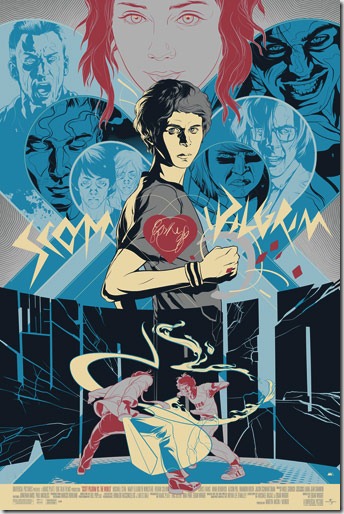
But what Scott Pilgrim really is is a love letter to visual storytelling. It’s a movie that lives to mesh images with words and dialogue and sounds to create something new and exciting. In adapting the original graphic novel Edgar Wright has gone far beyond the most abstracted examples (Ang Lee’s version of Hulk, Sin City) to mesh conceits of that storytelling style into a filmic space. Sound effects aren’t just given special notice, but they permeate the film. Scenes slide into frame like panels, with aggressive use of split screen and jump cuts to create the feeling of the original graphic novel without relying on the actual animation of said panels to overstate the point. Speed and sound lines drip off of everything. It’s lush with effects, creating a world that’s part cartoon and part comic book but still feeling complete and grounded in its own strange reality.
Scott Pilgrim is an ambitious film, in parts incredible action film, broad coming-of-age comedy, and off-beat romance. But what its eccentric cast represents is the broken individuals of my generation, people too self-aware to not realize that they’re a mess of cliché but unable to do anything about it but laugh at themselves. Nobody is wholly good, and the heroes are often as petty as the villains, but when isn’t that the case? For all its unreality, Scott Pilgrim presents a more colorful version of the life I think most people live out every day.
Of all the movies on this list, I feel Scott Pilgrim is the most fun, the most creative, and potentially the most flawed. But it is amazing for all the things it reaches for, even if it doesn’t quite capture them. It’s a film full of magic, insightful and clever even when it’s being stupid and awkward. For all its unrealities, it is about the truth of all of our dreams, the life we live within our imagination.
The Ghost Writer
directed by Roman Polanski
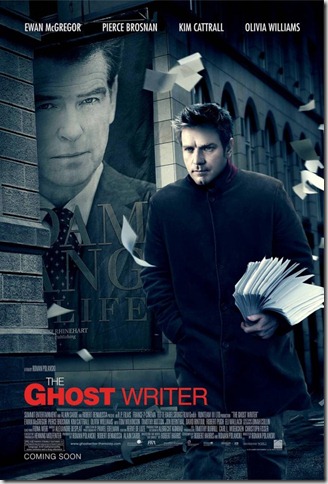
The best thing about The Ghost Writer is how muted it is as a thriller. It’s laid out from the outset that whatever secrets are here have caused the likely death of one person already, but at the same time the story is about an author doing research for a biography. The ticking clock so paramount to the genre is almost non-existent, with only the hazy idea of a deadline for the book keeping McGregor’s writer moving at times when he’d happily rather just not push deeper into the labyrinth of the plot.
And it’s that easy pace that really makes The Ghost Writer surprising. Things unfold almost casually but end up in dark places, with conspiracies and paranoia blossoming naturally in the environment of political intrigue we find ourselves. It’s obvious that nobody is entirely trustworthy but it’s not clear whether it’s because of some dark secret or because that is simply the reality of modern politics.
Special note should be given to Brosnan, who turns in perhaps his best performance as the beleaguered Adam Lang, a man who is little more than a pretty face in a nice suit to figurehead the motivations of others. It’s a subtle performance, a man deluded into thinking he has a legacy, slave to the policies set out by his betters. But Brosnan sells his helplessness with incredible charisma and empathy. When he arrives on scene, you want to believe he is what he claims to be, despite all evidence to the contrary.
It’s a film that’s slow to unwind, but when it does get to its tension points it does so with an understated brutality that feels all the more real for doing so. In many ways I was reminded of Michael Clayton, another thriller with a similarly muted sense of tension. And like Michael Clayton, it lives by its inspired cast. Also like Michael Clayton, it’s a fantastic film.
The American
directed by Anton Corbijn

The American is a quiet, understated film, a modern spin on French new wave cinema. As such, for a film about assassins and for the brutally violent opening, most of the run time of The American is muted and incredibly understated. Clooney’s unnamed assassin finds himself in a beautiful Italian village building a custom rifle for another assassin. At the same time, forces seem to be gathering against him, enemies hidden around every turn.
It’s a film content to be still, about the paranoia of a quiet morning spent contemplating the obvious oncoming fate, the presence of an actor inhabiting a role so comfortably that there’s little need for exposition or even dialogue. Instead it is devoted to a unique visual beauty—a fog drenched Italian city, beautiful women lit dimly in questionable places, the stark grace of Clooney assembling his instruments of death. The American is the most European of movies on this list, with sensibilities that run counter to most of modern cinema.
Which is what makes it so compelling to watch. The movie is intense and remote, an internal monologue that the audience is never let in on, relationships that are hinted at but rarely explored, and all driven by Clooney as a man of deep emotion and few words trying to keep alive and morally intact. It is a movie wrapped around the gravity of a single performance, that of Clooney reaffirming the argument that he’s the biggest star of his generation.
Mother
directed by Bong Joon-ho
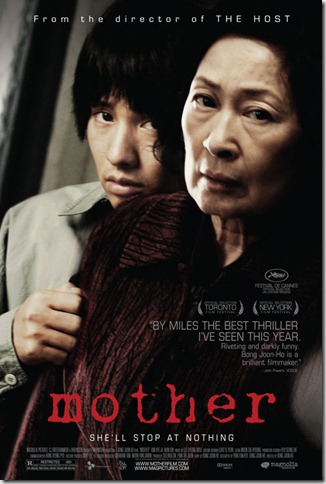
This all comes crashing down when a high school girl turns up dead and circumstantial evidence places Do-joon near the scene of the crime. The police, incompetent and bowing to intense public pressure (see Lady Vengeance for another example of appalling South Korean police work, which makes me wonder if there isn’t some truth to it) railroad Do-joon into custody, slapping him with an ineffectual attorney and tricking him into signing a confession.
This begins a quest by the Mother to prove Do-joon’s innocence, a trek that takes her throughout the town, uncovering the seedy truths of the world around her, finding her working with people she previously despised, as the truth slowly begins to reveal itself to her.
The trappings are straight out of the best noir, but where Mother excels is in how quickly it transcends them. What begins as one story slowly morphs into another, as events take wild left turns that shock and horrify, but never seem out of place. It is an amazing character study, a deep exploration of just how far a parent’s love can go, and the dark places to which it leads. It is in many ways a genre mashup, a close-to-the-vest thriller, a strangely touching character piece, all wrapped in an amateur detective story. But it remains incredibly compelling, powerfully acted and beautifully shot, even as it strays down the darkest of alleys.
I’m Still Here
directed by Casey Affleck

I’m Still Here is first and foremost an uncomfortable film. Even knowing that Joaquin’s performance as an unraveling version of himself is indeed a performance, it’s painful to watch. He’s erratic, moody, his body and thoughts seeming to disintegrate in tandem from the figure audiences had come to know from his movies. That it’s captured with all the graceless mess of a seemingly home movie makes it all the more jarring. It is a party that has long since ceased to be fun, yet everyone is still there going at it just the same.
It’s obvious even from the beginning that his aspirations at a music career are little more than a pipe dream. He’s actively terrible, clueless as to how to begin and pushy and oblivious when people start trying to call him on the fact that he’s no musician. Yet, for all of this, the people closest to him and the people fartherst away, the celebrity watchers, do nothing. And that’s where the most troubling aspects of the movie come in. Despite his obviously unwell state, nobody stops it. Nobody from the outside steps in and tries to intervene. The celebrity gossip machine marches forth, jokes aplenty, steamrolling over what could have been the last gasp of a very troubled man. But who cares, right? Everyone is far too self-invested or too skeptical to genuinely be concerned.
It’s a good thing the performance was just that, because otherwise everyone on that film would have been an accomplice to something awful, obviously neglecting a person in need of serious help. And it’s that neglect that is most obvious in the film. This idea of stardom, of expectation, comes with it an easy disregard when people don’t live up to those images we project of them. Joaquin puts himself forward as a sacrifice to this machine of parody and spite, turning the lens more on it than himself. It is not a perfect film, but it’s a movie that dares to turn our fascination with celebrity back on us and ask whether or not we truly care or are just looking for the next scandal, the next tabloid explosion.
I Am Love
directed by Luca Guadagnino
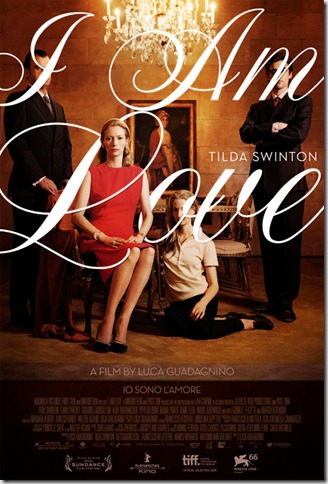
I Am Love is a movie about the wealthy Recchi family, Italian textile manufacturers. Tancredi, recent heir to the family business, is left in co-ownership with his recalcitrant son Edoardo. Tancredi’s wife, Emma, played by Swinton, is a native-Russian who in this period of familial turmoil begins to grow disaffected with the formal matriarchal status that has been thrust upon her, and begins to explore the idea of an affair with her son’s best friend, a chef named Antonio.
Which doesn’t begin to touch the magic of this movie. The reality of I Am Love is one of a passionate spirit, long fettered by responsibility, beginning to shake that repression and rediscover a more sensual side of life. And it is expressed to perfection by the etherial Swinton, who carries the entire film, selling the fact she speaks Italian and Russian and not a lick of English, incredibly empathetic as a woman who is exploring new frontiers in her life.

The Social Network
directed by David Fincher
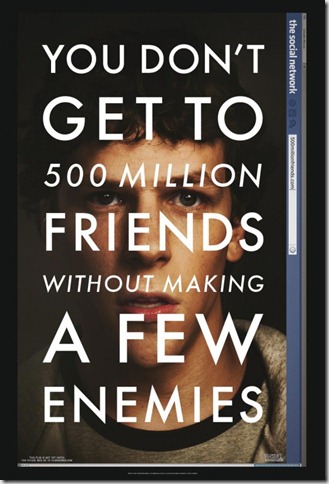
Love him or hate him, Zuckerberg is a presence in the world. But Fincher and Sorkin’s triumph is dragging what is a very insular, introverted personality out onto the screen, to be analyzed and critiqued and finally made relatable. For all the buzz about how negative the portrayal of Facebook founder Mark Zuckerberg is in this movie, Jessie Eisenberg’s portrayal is, from the first moment, of a fragile man uncomfortable with everything in life but the inside of his own head.
It’s easy to melt down the film into the broad strokes of what did or didn’t happen, but what’s great about The Social Network is how little that reality matters. The movie isn’t about telling us a true story, it’s about showing the perils of genius, the tenuousness of friendship in the face of ambition, and the ephemeral nature of all of our relationships in the modern era. Enemies, rivals, friends, business partners, it’s all relative and fluid and changing at the speed of light. The Social Network is a frame of interaction in the era of the internet, both seen from the outside and living in that moment. It is the first great comment of many on the aughts, reflective without nostalgia, critical without anger or ignorance.
127 Hours
directed by Danny Boyle
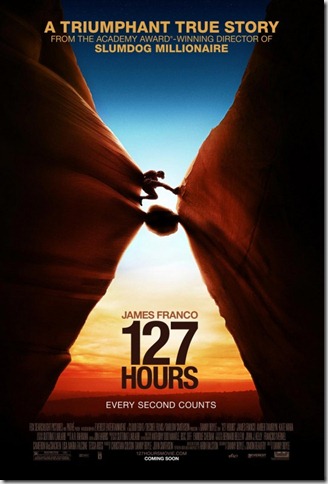
Except that’s not really what 127 Hours is about. Yes, Franco as Ralston gets trapped under a rock. And yes, it has a similarly gruesomely triumphant ending, but the reality of the film is vastly different than the abstraction.
First off is Danny Boyle’s typically hyperkinetic style. It creates an amazing juxtaposition here between the modern life and internal monologue of Ralston and the incredible, monolithic static position he finds himself in. It’s a film that balances perfectly between the concrete and the subjective. It’s a delicate line, but it is expressed with incredible compassion for the subject matter.
But the real key is the story that’s hung upon the facts of the situation. Ralston’s story is one of survival, but in Boyle’s hands its transformed into an ode to the human spirit. It is about the need for others, the struggle of the individual versus the social realities of today, a flawed hero discovering truths through suffering that would never have otherwise occurred to him.
It all runs a huge risk of being saccharine and preachy, but the film is neither of those things. It’s swift and beautiful and shocking, but never does it rely too heavily on sentiment. There isn’t enough lucidity in Ralston’s experience, and too much bravery in Franco’s performance, for anything so easy.
Exit Through the Gift Shop
directed by Banksy
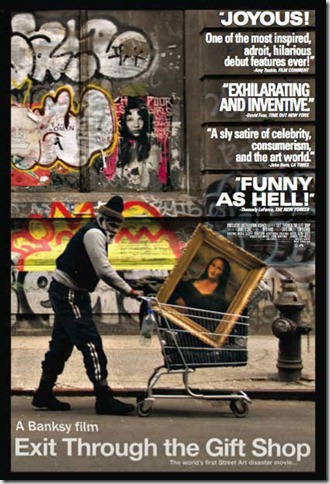
Initially the story of Thierry Guetta, a French immigrant in Los Angeles who becomes obsessed with street art. Taking a camera and heading out into the night, he begins assembling the largest collection of first hand footage of the subject ever assembled, charting much of the emergence of the movement. However, after an encounter with the enigmatic Banksy, it is revealed that for the thousands of hours of footage Guetta has filmed, he has no motivation or ability to put it together into the documentary he’s so fervently talked up. Banksy offers to take custodianship of the footage in order to piece together something coherent from the madness and sends Guetta off to practice the street art he’s been so fascinated with.
What happens next is part farce and part scathing critique of the art community, but it never feels untrue and never descends to outright parody. Exit Through the Gift Shop is amazing in how fine a line it walks, exploring the pretentions of the art world without openly criticizing them or where they come from, encouraging people to explore their own artistic talents by interviews with the most passionate, devoted street artists of the medium. But it’s also a cautionary tale, a story of too little talent and too much ambition, the power of hype, the dangers of association.
It is the perfect companion piece to a movement as controversial and divisive as modern street art, a loving tribute and a bitter critique, all wrapped up in an otherwise straightforward attempt to chronicle the history of the form. The film is a work of art, Banksy’s insightful commentary on a medium he rose to the top of, a fable about dreams and where they can get you. Truth or not, it is honest and incredibly compelling.
Tangled
directed by Nathan Greno, Byron Howard
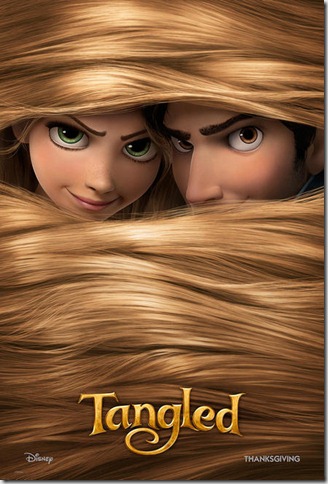
Thankfully, the ads were simply terrible, and the movie was not. In fact, it was great. Tangled is easily the best thing Disney’s produced since Lilo & Stitch, and might belong to some of the best of their work from the mid-90s. From the incredibly expressive, painted art style of the CG to the smart updates of the ‘Princess’ mythologies of Disney’s greater works, Tangled is a pretty remarkable achievement from a studio that’s been turning out work that ranged from meh to downright bad for years.
The real triumph of Tangled is in its characters. Rapunzel balances the enthusiasm of a young woman just learning to explore the greater world with the sadness and neurosis of someone who has been so reliant upon their (abusive) caretaker all their life. The male lead, Flynn Rider, is a great subversive send up of the typical bravado-driven male leads in animated features in the past two decades without falling into easy parody.
But the really amazing thing here is how the villain Mother Gothel, the woman who kidnapped and raised Rapunzel for her magical hair, relates to Rapunzel. It’s an amazingly subtle dynamic, a parent who keeps her child under her thumb by instilling self-doubt and poor self-image through infuriating and all-too-relatable passive-aggressive jabs. It’s a smart piece of work, and speaks to a more realistic way people relate to people, and parents sometimes relate to children, than you see in almost any animated feature that isn’t by Miyazaki.
It’s a surprising movie, on all fronts. There’s a maturity of story-telling, without relying on pop culture references or jokes that only play to adults or kids, that is hard to resist. There was a time when Disney produced some of the greatest movies, not just of animation but of the medium of film. Tangled is a great attempt to once again reach towards something greater than the narrow, disappointing box most children’s animation has been in in the modern era.
True Grit
directed by Joel and Ethan Coen
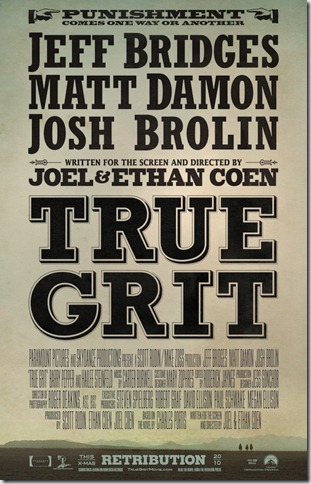
True Grit is, at its core, a coming of age story. One girl with one task, set out in a world of uncertainty and danger, trying to find her way. Which seems almost too simple, but in the Coen Brothers hands becomes something pretty magical. What purports to be a morality tale about the triumph of good over evil becomes an awakening to the villain in all people, the goodness and honor that even murderers carry. From the first scene, where young Mattie Ross stands stoically as condemned men speak their last words before being hanged, to the end where she is negotiating with outlaws, it is a morality tale set in an amoral time, a piece that makes no moral judgments. The men Mattie hires are as good and as evil as the man she seeks to capture.
It’s amazing that a film hinges so heavily on an unknown actress, but Hailee Steinfield stands up to Jeff Bridges and Matt Damon giving pitch-perfect performances and not only holds her own but steals many of the scenes she’s in. Special mention needs to be given to Damon, however, who is at his unlikable best as a boastful, slimy Texas Ranger who hits all the right notes of being an utter ass but who is, in many ways, the only real hero of the story. It’s an impressive, surprising piece of character work, up there with Damon’s perfect performance in The Informant.
For all of its intimacy, though, True Grit plays out with the epic scope befitting a Western. The Coen Brothers shoot a beautiful film, a dirty revisionist take on the Western that sometimes ascends to the abstract without feeling jarring. It is the desolate landscape writ large, made immediate and evocative, the perfect existential setting for the characters to inhabit. And they take to it perfectly, with some of the best dialogue in any movie this year, and one of the most compelling small character pieces. For all the buzz Winter’s Bone got this year, I feel this is the movie that best reflects a young woman navigating through a space where the world of black and white becomes a world of greys.
Black Swan
directed by Darren Aronofsky

Yet for all of the precarious wire-work the film does in moments like these, when the erotic thriller moments dictate the plot beats, Black Swan is a film to be marveled at. Because as dangerously close to camp as Black Swan veers, it does so within the context of its story, one of madness and unreality, the artifice of art and the all too real impacts it has upon those who pursue illusive ideas like ‘perfection’. Black Swan is a movie almost beguilingly without a twist, the ending presented to you within the first ten minutes of the movie yet so perfectly pitched that even when you know how it will (how it must) end, you find yourself wishing for a different result.
And that is the genius of the film. As Natalie Portman’s character Nina descends deeper and deeper down into a place of devotion to craft that we know will exact a high price, we are torn between wishing it didn’t have to be this way and breathlessly hoping to see what emerges once she passes that metaphorical line in the sand. And Portman doesn’t disappoint. Her performance is the best she’s ever done, easily the best acting I have seen this year (and many others), until the finale, when the curtain falls and we’re left with an inevitable end that still manages to touch and move with an immediacy and passion that belies its ancient roots.
Black Swan is more than a great movie, it is also a great dark fairy tale, a mood piece on art and personality, about the warring sides within all of us, and about the eternal chase for the impossibility of perfection and the power of humanity to realize artistic dreams at any cost.


